In 2024 the state of Pará grew 89.5% of Brazil’s acai, according to IBGE, Brazil’s statistics office. Acai, written açaí in Portuguese, is the fruit of a palm, Euterpe oleracea, that grows along the rivers of the Amazon estuary.
The berry is mostly stone. What people eat is the thin layer of pulp around it, which is softened in water, pulped and frozen close to where it is picked, because it does not keep.
Speed is the constraint. Sebrae, Brazil’s small-business service, puts the processing window at about 24 hours from picking, and a 50 kg sack of fruit gives roughly 20 litres of pulp.
Brazil harvested 1.99 million tonnes of the fruit in 2024, according to a March 2026 technical note from Fapespa, the state of Pará’s research foundation, working from IBGE data. About 60% of it comes from ten municipalities in Pará, and Igarapé-Miri alone produced 261.9 thousand tonnes.
Most of that is now farmed. Conab, Brazil’s national food supply company, puts the cultivated harvest at 1.74 million tonnes against 247,000 tonnes picked from wild palms. Between 70% and 80% of Pará’s crop comes in from July to December, Embrapa reports, which is why irrigated planting on higher ground has spread to cover the rest of the year.
In Pará it is an everyday food, often eaten unsweetened alongside fish or farinha. The cold, sweet bowl that most people in Europe know is the export version.
Plain pulp against sweetened pulp
TACO, Brazil’s food composition table, compiled at Unicamp, lists 100 g of plain frozen pulp at 58 kcal, with 3.9 g of fat, 6.2 g of carbohydrate and 0.8 g of protein. Most of the energy comes from fat, which surprises people who expect a sweet berry.
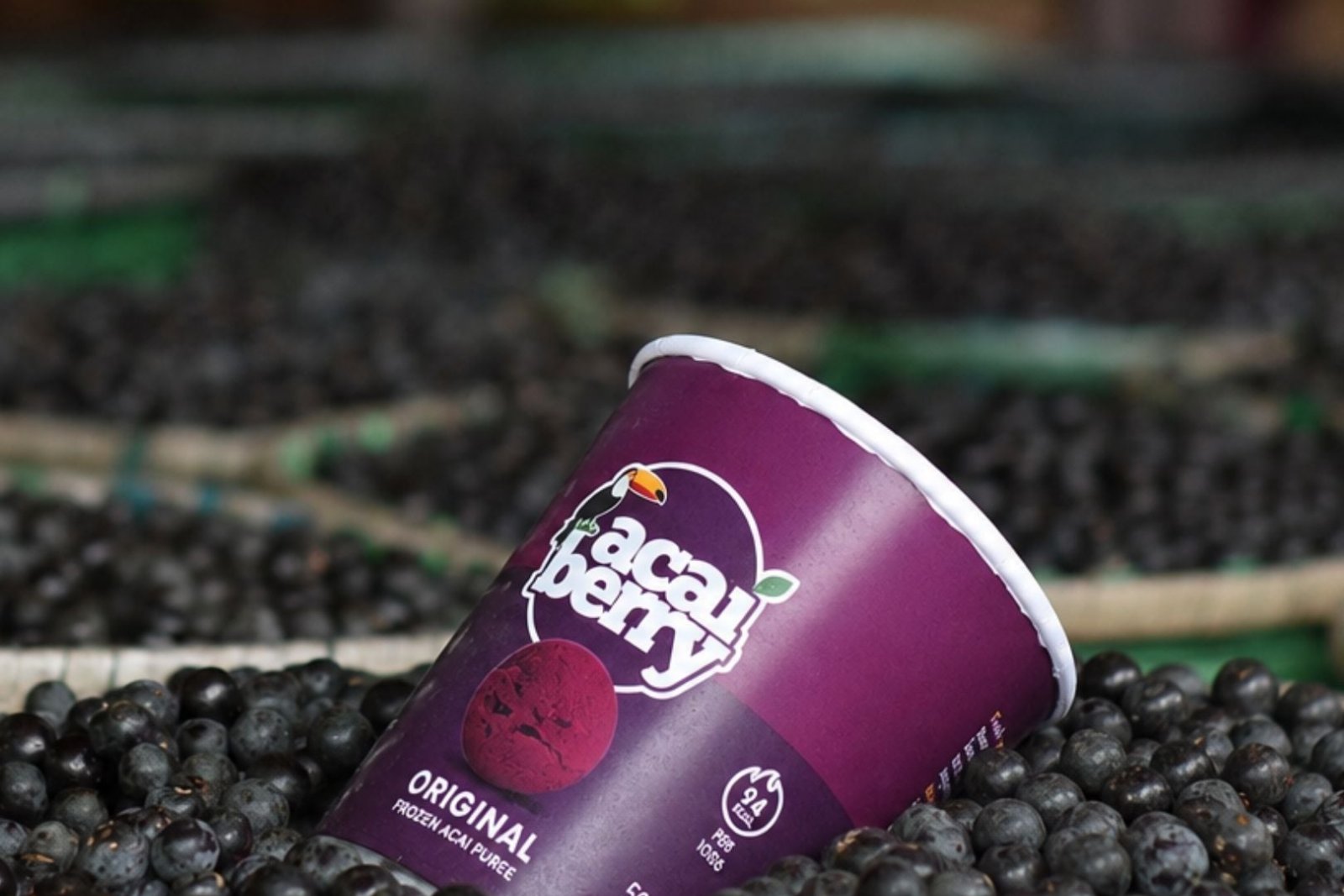
The sweetened version, made with guaraná syrup and glucose, comes to 110 kcal per 100 g in the same table, with 21.5 g of carbohydrate. Our tubs are sweetened too: cane sugar and glucose follow the acai purée on the ingredients list below.
The fat is mostly oleic acid, about 62% of the oil, and the purple colour comes from anthocyanins, chiefly cyanidin-3-glucoside and cyanidin-3-rutinoside, according to a 2024 paper in Frontiers in Nutrition.
Its effect on health is less settled than its marketing suggests. The US National Center for Complementary and Integrative Health says there is little research in people, and not enough reliable information to support its use for any health purpose.
What is in our tubs
Acai purée (organic acai and filtered water) 70%, cane sugar, glucose, guaraná extract, stabilisers (xanthan gum, guar gum), citric acid. Vegan, and free from the 14 declarable allergens.
For what plain acai pulp contains, measured against Brazil’s own food composition table, see What acai is, and what it isn’t. For how it travels from the Amazon to London, see Where acai comes from.